Lead Time Expectations for Custom Lab Diamond Jewelry
Custom lab-grown diamond jewelry has become a core competitive product in the modern fashion jewelry industry. Combining personalized design, cost-effective lab diamond materials and exquisite handmade craftsmanship, it is widely favored by boutique brands, cross-border e-commerce sellers and customized retail merchants worldwide. Unlike finished standard jewelry, custom lab diamond pieces involve exclusive design, personalized stone matching and tailored inlay processes, resulting in flexible and variable production lead times. For buyers, brand operators and procurement personnel, accurately grasping lead time rules, distinguishing sample and mass production cycles, identifying key influencing factors, and standardizing delivery node agreements with manufacturers are the keys to stable supply chain operation, order scheduling and customer satisfaction improvement. This article comprehensively sorts out the full-cycle lead time expectations of custom lab diamond jewelry, analyzes core influencing factors, and summarizes standardized delivery agreement methods for industry reference.
1. Core Distinction: Sample Lead Time vs. Mass Production Lead Time
The biggest misunderstanding in custom lab diamond jewelry procurement is confusing sample development cycles with bulk order delivery cycles. The two links have completely different process flows, workloads and time standards. Clarifying their differences is the premise of reasonable delivery expectation management.
1.1 Custom Sample Lead Time (Pre-production Prototype)
Sample making is a single-piece customized production link for confirming design effect, diamond matching, inlay technology and overall workmanship, which serves for final order confirmation and market display. The process focuses on precision verification rather than mass production efficiency, with a relatively short cycle. The standard lead time for custom lab diamond jewelry samples is 7–15 working days, covering the whole process from design confirmation to finished sample delivery.
Specific time breakdown is as follows: 1–3 working days for 3D modeling and design revision confirmation; 2–3 working days for lab diamond stone selection and preparation; 3–5 working days for single-piece mold opening, wax injection, polishing, inlay and post-processing; 1–2 working days for quality inspection and sample photography. For highly complex customized styles (such as multi-layer stacking, full pavé inlay, special-shaped diamond combination), the sample cycle will be extended to 18–20 working days due to repeated process debugging.
1.2 Mass Production Lead Time (Bulk Order Delivery)
Mass production is batch standardized production on the basis of confirmed samples, focusing on uniform product quality and stable production efficiency. On the premise of finalized design, confirmed sample and stable process, the standard mass production lead time for custom lab diamond jewelry is 20–35 working days.
The mass production cycle includes batch material preparation, batch mold opening, mass casting, unified inlay, secondary polishing, electroplating, finished product inspection and packaging. Compared with sample making, mass production needs to coordinate batch raw material scheduling, assembly line arrangement and quality consistency control, so the overall cycle is longer. For orders with large quantities (more than 500 pieces) or customized batch details (such as personalized engraving, exclusive electroplating color), the delivery cycle will be extended to 40–45 working days. It is worth noting that mass production lead time is calculated from the date of sample final confirmation and deposit arrival, not the date of initial design consultation.
2. Three Core Factors That Determine Custom Lab Diamond Jewelry Lead Time
Different from ordinary alloy and stainless steel custom jewelry, lab diamond customized products have stricter requirements for design presentation, stone matching and process precision. The fluctuation of lead time is mainly affected by three key links: 3D modeling design, lab diamond stone preparation, and personalized inlay technology. Each link will directly affect the overall production cycle and delivery efficiency.
2.1 3D Modeling & Design Confirmation Cycle
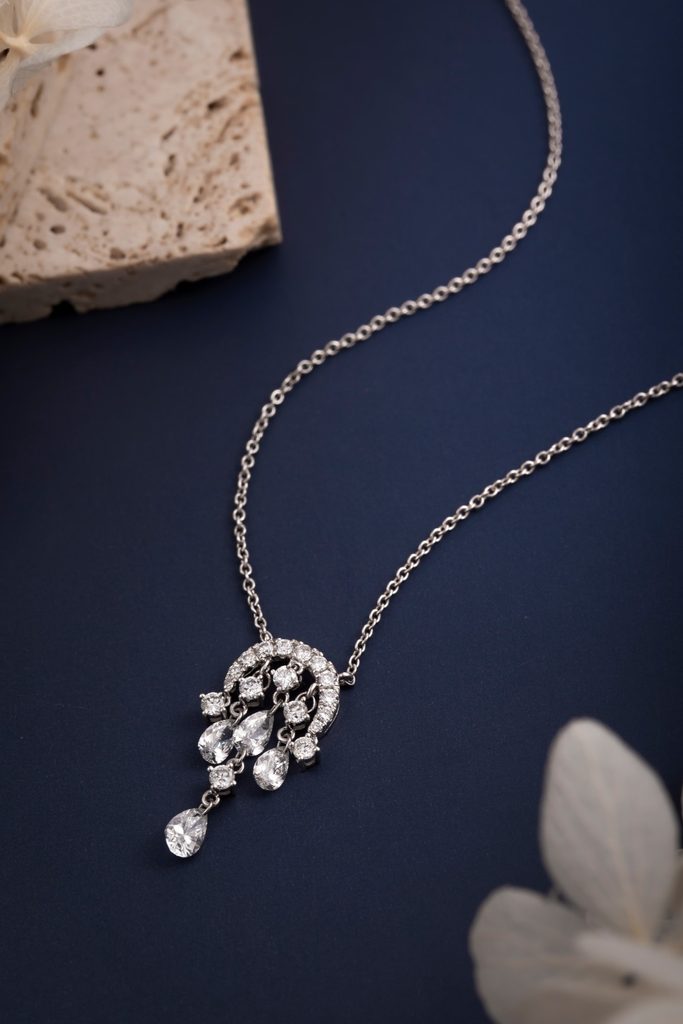
3D modeling is the first step of all custom lab diamond jewelry production and the fundamental basis for subsequent stone matching, mold opening and inlay. The efficiency of this link directly determines the start time of the whole production process. Conventional simple styles (solitaire rings, basic pendant necklaces) can complete 3D modeling and draft output within 1–2 working days, with simple parameter adjustments that can be confirmed quickly.
However, complex customized designs will significantly prolong the cycle: multi-stone combination styles, hollow carving designs, vintage layered structures, and personalized contour customization require designers to repeatedly optimize the model structure, verify diamond inlay positions and adjust dimensional proportions. In addition, repeated revision requirements from buyers (style adjustment, size modification, detail optimization) will also lead to delayed design confirmation. Unconfirmed 3D drawings will suspend all subsequent production links, making it the most common cause of early delivery delays.
2.2 Lab Diamond Stone Sourcing & Stock Preparation
Lab-grown diamonds are the core core materials of customized jewelry, and stone preparation is the link with the largest uncertainty in the cycle. Unlike natural diamonds with fixed inventory, lab diamonds have diverse customization dimensions, including carat weight, cut, color, clarity, shape (round, princess, emerald, pear, heart shape) and fluorescence parameters.
For conventional standard lab diamonds (round brilliant cut, standard color and clarity), regular manufacturers have spot inventory, and the preparation time only takes 2–3 working days. But for special-shaped customized diamonds, ultra-high color/clarity grades, customized carat precision and special fluorescence-free parameters, manufacturers need to adjust goods from upstream diamond factories or carry out targeted cutting and polishing, with a preparation cycle of 7–15 working days. In addition, for batch customized orders with mixed stone sizes and mixed shapes, the sorting, matching and quality inspection of bulk diamonds will also increase the material preparation cycle. Once the stone supply is delayed, the subsequent inlay and post-production links will all be suspended.
2.3 Personalized Inlay & Craft Difficulty
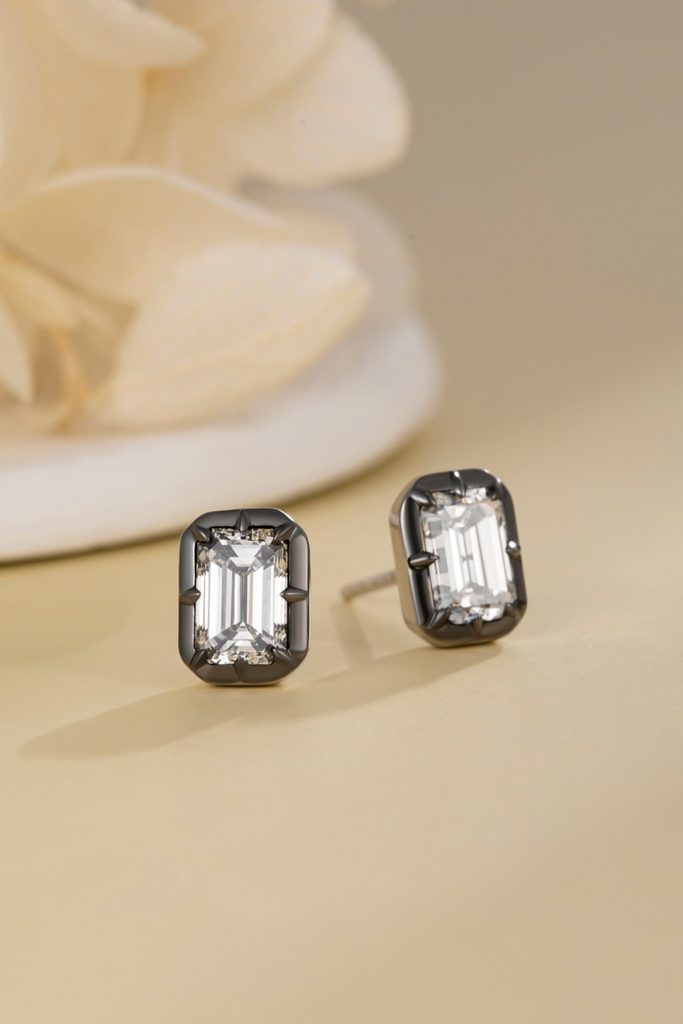
The inlay process determines the final quality and production efficiency of lab diamond jewelry, and different craft types bring obvious differences in production cycles. Conventional basic inlay processes (prong setting, bezel setting) are mature and standardized, with high assembly line efficiency, which will not cause obvious cycle delay.
In contrast, high-precision and complex customized processes consume more working hours: pavé setting, channel setting, invisible setting and micro-set technology require manual fine operation by senior craftsmen to ensure uniform diamond spacing, firm inlay and no deviation; vintage handmade texture, hollow micro-carving, multi-layer mosaic and other personalized crafts have low mechanization degree, relying on manual polishing and fine adjustment. In addition, customized processes such as personalized laser engraving, exclusive electroplating color (matte gold, rose gold, black gunmetal) and secondary anti-oxidation treatment will also increase the production time by 3–7 working days. The higher the process precision and personalized degree, the longer the inlay and post-processing cycle.
3. How to Form Standard Delivery Node Agreements with Custom Jewelry Manufacturers
Unclear delivery node agreements are the main cause of delivery disputes between buyers and manufacturers. To avoid delayed delivery, cycle disputes and order losses, both parties need to clarify standardized node rules in the cooperation contract, covering design confirmation, sample delivery, mass production start time, phased nodes and delayed liability. The following is a complete set of executable agreement specifications.
3.1 Clarify the Starting Time of Cycle Calculation
Explicitly stipulate in the contract that all lead time calculations are based on the date of double confirmation: buyer’s final confirmation of 3D design drawings + arrival of the agreed deposit. Avoid ambiguous descriptions such as “starting from the consultation date”. At the same time, clarify that any subsequent design revisions, parameter adjustments or process changes proposed by the buyer will reset the production cycle, and the extended time shall be borne by the proposing party, so as to avoid cycle disputes caused by repeated revisions.
3.2 Split Phased Delivery Nodes for Full Process Supervision
Decompose the whole customization process into measurable phased nodes, and clarify the time limit and delivery standard of each link to realize transparent order progress:
1. Design node: The manufacturer completes the first draft of 3D modeling within 1–3 working days after receiving the deposit, and completes revision and final confirmation within the agreed time;
2. Sample node: Complete sample production, quality inspection and deliver sample photos/videos for confirmation within the agreed sample cycle; if the sample is unqualified, clarify the re-production time limit;
3. Mass production node: Start batch production within 2 working days after sample confirmation, complete batch material preparation, inlay and processing in stages;
4. Final delivery node: Complete finished product quality inspection, packaging and delivery within the agreed mass production cycle, and provide logistics tracking information in real time.
3.3 Confirm Special Circumstances and Delay Liability Clauses
Fully preset uncertain factors in customized production and clarify liability division: First, for objective delays (upstream diamond supply delay, factory regular maintenance, force majeure factors), the manufacturer shall notify the buyer in writing 3 working days in advance, and both parties negotiate to adjust the delivery date; second, for subjective delays (manufacturer’s process arrangement error, production efficiency lag, unqualified product rework), clarify the compensation standard for delayed delivery; third, for buyer-induced delays (late confirmation of drawings, delayed payment, temporary modification of customization requirements), clarify that the cycle is automatically extended without manufacturer liability.
3.4 Reserve Flexible Buffer Time for Bulk Orders
For large-batch custom orders and festival peak orders, it is necessary to agree on a 3–5 working days buffer period in the contract. The buffer time is used to deal with unqualified product rework, temporary material adjustment and process fine-tuning, which can effectively avoid delivery pressure caused by small fluctuations in the production process and ensure on-time final delivery.
4. Conclusion
The lead time of custom lab diamond jewelry is a systematic cycle affected by design, materials and technology. Distinguishing the differentiated cycles of sample development and mass production, mastering the core influencing rules of 3D modeling, diamond stocking and inlay technology, and formulating standardized phased delivery agreements with manufacturers are essential capabilities for customized jewelry procurement and supply chain management. Clear lead time expectations and standardized node cooperation can not only effectively avoid delivery disputes and control order risks, but also greatly improve the efficiency of customized production, help buyers accurately arrange sales plans, and finally achieve stable and long-term cooperative operation with manufacturers.
Leave a Reply